Author: Fara

  • Toxic Energy: Little Miss Potentiality Returns

    Thalia Drori presents her dark comedy, Toxic Energy

    Little Miss Potentiality returns, to answer the question: why is the mayor of Richmond, California developing an LSD-like drug that makes people dance naked? She joins forces with a massage parlor coworker and a lobotomized TV reporter. Together they race to uncover the devious mayor’s plot to stay in power, while a toxic cloud threatens to engulf the city.

    Shot on 16mm black and white in the style of the silent film era with intertitles, the film’s pale, deadpan heroine was first introduced in the short film, Little Miss Potentiality. Toxic Energy features a musical score by Roddy Bottum (Faith No More, Imperial Teen) and the voices of KPFA radio personalities Kris Welch and Phillip Maldari.

    As Little Miss Potentiality navigates through visiting relatives, a pseudo-communist boyfriend and her own simple aspirations, she fights to save a community.

    “The story is taken from a combination of actual events, including a toxic cloud that hung over Richmond, California in the early nineties,” reveals writer and director, Drori. “It also explores the politics and problems faced by a community that lives and works near large chemical plants. The film is about action versus rhetoric.”

    “As is the case with most of my films, it is autobiographical,” she continues. “The characters are people I know, people I have encountered working in the sex industry and in the corporate world, from musicians to corrupt politicians to clergymen.” The film was shot in Minneapolis, St. Paul and California with local talent. Matt Ehling served as Director of Photography.

    BIOGRAPHY

    Thalia Drori is a DIY writer, producer, and director of motion pictures -experimental, documentary and narrative, from Oakland, CA. She became a full-time faculty member at the Minneapolis College of Art and Design in 1998 and in 2005 she founded Cineastas de Granada, a free of charge video production program for teenage girls in Granada, Nicaragua.

    Director’s Statement:
    Dark and surreal comedies, my recent films are about sexual politics and secretive behavior. The images and stories stem from my discomfort with the hidden, with what is behind the curtain. My films are uncensored female fantasies, focusing on revenge, fear and horror. In each of them, the protagonist exists as a “straight man” in whose still face is written the alienation she absorbs from the melodramatic world around her. Like the group hug that turns into an opportunity to cop a feel, my work embraces mainstream Hollywood’s comforting and sensuous form, while it simultaneously takes advantage of the innocence of that form by telling non-traditional stories and by using unorthodox content. Within the context of film as the coquettish seductress, I am exploring strategies to 
    describe the female inner world.
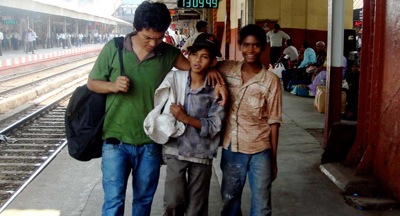
  • Lucky Express: A documentary on India’s train kids

    Lucky Express: a full length feature documentary that winds through India’s railways and stations, in the company of destitute children who have made Indian Railways their vast network and home. Confiding their life stories, fears, hopes and dreams, these disowned and abandoned youngsters  astonishingly entrust their sobering reality to Lucky – former train station vagrant. Through him, we experience a rare and intimate connection, shaping the tone of the film. Criss-crossing the plains of India all the way to Nepal, we wind our way up the foothills of the Himalayas in search of Lucky’s family.

    No one knows the exact number of abandoned and abused runaway children who have been forced to live their lives in the train stations of India. Social workers have counted up to two hundred children arriving at the larger stations every day.  According to UNICEF, there are approximately eleven million child runaways in India. More than 70% of these children are less than fourteen years old, and it is not uncommon to see children as young as three year olds among them. They work as soon as they are able to speak.

    With over 39,450 miles of tracks, 15,000 trains, 11 million passengers daily, 1.6 million employees and over 7,000 stations, Indian Railways is a universe unto itself—a seething, endlessly energized network through which pass all the diverse cultures of the subcontinent and its billion-plus souls.

    Why are they found at the train stations? The stations provide access to public toilets, water and—most importantly—leftover food and opportunities to make money. Children are involved in a variety of different work at the train stations, including begging, vending, rag-picking, performing for travelers, cleaning and sweeping, shoe shining, and selling refilled bottles of water. Bottle collecting is one of the most common enterprises: empty water bottles are abandoned by passengers, gathered by the children, and brought to local recycling houses, where the kids receive no more than a pittance for their efforts. At the very most, children might make 150 rupees (ca US$3) a day from bottle collecting—spent immediately either on food or on such goods as  glue for sniffing. Money can never be saved, of course; what isn’t spent is usually stolen by other children, by gang members or pimps. An estimated 90% of the children are engaged in substance abuse.

    These children are in constant danger. It has been estimated that it takes an average of twenty minutes after arrival at a station before a child is approached by an older sexual predator, or is offered drugs in exchange for sex. Some children have to prostitute themselves to gang members in order to ensure themselves a somewhat safe place to sleep at the station. Life is hard, a daily struggle to survive. As the children get older, their only chance of survival is to to join the gangs. Life at the train stations is as tough as it gets for a kid in India.


    info: http://www.luckyexpress.org

  • Periwinkle Cinema presents: our June Spectacular

    The month of June is considered pride month, when the LGBTQ community is celebrated for its part in the diversity of the greater community of human kind. Periwinkle Cinema presents our June Spectacular: a celebration of queer visions as part of our monthly commitment to the queer film/video community. Curated by Lorin Murphy.

    program:
    Krystal by Eliane Lima
    First Comes Love by Evie Leder
    Chin Up by Mev Luna with Guillermo Galindo
    Time Fuck by Emily May Wingren
    Disaster Movies 1,2,3 by Lorin Murphy with music by Grale
    Terrorist She-Freaks of Texas by Bug Davidson
    Gossamer Walls by Malic Amalya and Peter Miller
    At Least You Know You Exist by Zackary Drucker
    In Poch@hood by Lina Blanca Ogden
    The City That Made My Future by Lee Hunter
    Delirious by Ryan Murphy

    Periwinkle Cinema is a community-run queer film and video art series. Our screenings were started by filmmaker Lorin Murphy at the legendary big GAY warehouse. The series is produced by Lorin and a bunch of awesome volunteers. All money from admission helps support Bay Area queer filmmakers through our community projects & cash awards!