 We asked Claire Bain a few questions about her upcoming presentation of The Nova Avon, at ATA on Friday, August 9.
What is “The Nova Avon” all about? Can you tell us what inspire you to start this project?
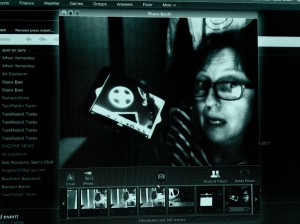
“The Nova Avon” is about systems-identity-power: mass media and surveillance systems, sociological systems; identity and persona; interpersonal, economic, and political power. Using social media, this project consists of fictional characters that have real pages on Facebook, Twitter, Blogger, and YouTube. Using the format of the photos, videos, and text that people use on social media (in other words, snapshot cellphone pics & videos, texts, etc.) these characters’ lives are plotted out in real time, bit by bit, post by post. I portray most of the characters, male and female, and some other folks are involved, portraying characters either in my pictures or videos, or online in pages that they make. I know of one other fictional Internet character that interacts with me and my characters. There are some real people who interact with my fake Internet folks, too.
I was inspired to make this project four years ago when I saw TV commercials for smartphones, and there were generational conflicts between the characters in the commercials. The parents were annoying and embarrassing the kids by posting banal comments on Twitter and writing “I love you” on their Facebook walls. I had heard about people being stranded and using Facebook to get help, and I’d seen a couple of Twitter novels and video projects. I was writing some short fiction at the time, and I thought of making a Twitter novel, so I created this character, Nova Avon. The plot was that she would unknowingly buy a purse that had a secret item in it, and get kidnapped by people connected with that item. I gave her a backstory as a mid-level marketing manager from Middle America, in her early 30′s, who came here for a great job she had landed. I even had pictures of a great yellow purse (still on her Twitter page, @novaav). I started tweeting her story, but realized that I didn’t want a closed story arc, and that any audience reading it might start in after the beginning of her story. So I changed the narrative idea to the same story arc as most people’s on social media: flat. Nova meets some interesting people, and shares about her interesting brother, Bret…
The audience will have the opportunity to collaborate by making content during the presentation. Would this be the first time you allow this to happen? Why is collaborative content making important for the project?
It’s sort of the second time since I got out of art school (I did one interactive music project in a class at the SF Art Institute where the audience created words and chose musical notes) that the audience creates content. The first was a performance I did at Somarts where I took a panoramic photo of the audience and posted it on Facebook immediately as part of the performance ( http://www.flickr.com/photos/somarts/6507164311/ – http://blogs.sfweekly.com/exhibitionist/2011/12/100_artists_1_hole.php )
Collaborative content making is important not only because that is the nature of social media, but because at this program, we will work in meat space, a compliment to the mediated interactive space of the Internet. I look forward to whatever it is the “audience” comes up with. As soon as they participate, they are no longer the audience. They become the performers. That is fun! It also approaches the communal impulse of the crowd sourcing and participatory activities in current media. But a lot of consumer participation these days is really a form of manipulated free advertising or generating of capital for corporations. So if we create media together at this event, and employ some fakery, we’ll gain the opportunity to question what we are consuming in the future. Maybe sharpen our media literacy.
What has been the biggest challenge during the making of “The Nova Avon”?
At first I got really disappointed that hardly anyone looked at the project, even among my friends. Then a good friend in Germany (a professor of American studies) read it, and I felt happy. She missed some of it, because it branches out over several blogs, feeds, pages, hyperlinks, etc. It’s a little complicated unless one has the patience to click on all of the links. It’s like a micro internet; depending on how one uses it, different paths open up. Now I’m not so concerned about gaining an audience (a good thing, since I started it in 2009!)…it will exist on the Internet for a long time. I will eventually print it, and maybe convert it to some other online format that’s consolidated–an app, perhaps? 😉 It’s really quite easy because I can behave like anyone else using social media, and post whenever I feel like it. Right now the only challenge is to keep updating the characters’ pages and checking their email so they won’t get shut down. Somehow Facebook caught on to one of the characters and changed her to “Just for fun” status ( http://risingsuninstitute.blogspot.com/ )
Is “The Nova Avon” eventually going to have an end? If so, do you have any idea of how?
At this time, I don’t know if I’ll end it. I intend to keep going with it because it’s fun, easy, and a vehicle for all kinds of new ideas. I love the Internet as artistic medium! This project is an extension or branch of my persona-based film, video, and performance art. If you don’t count an alter-ego named Applebee Crockocidile, whom I performed for my mom and sister occasionally when I was a teenager, I began creating personae in film school. The first character was named Vel Richards, and she was a middle-aged lady that I made super-8 sound films about, in which Alfred Hernandez, John Steiner, and other artists acted. For “The Nova Avon,” I created a character named Burn Richards (acted by filmmaker Andy Burns http://nova-notes.blogspot.com/2010/09/burn-richards.html?utm_source=BP_recent ); he is Vel’s husband, and I decided that Vel is deceased. But she lives on in portraits on Burn’s wall. So the characters may come and go, but the project will live on.
Do you hope your presentation encourages people to think about their real and virtual interactions differently? If so, how?
Yes, I hope it does encourage reflection on interactions–that is one of the underlying reasons for making the project, and much of my work. I’m interested in the ways people attempt to hide or misrepresent themselves, and how we can mis-read or assign identities to others. All of which can be magnified on social media, and some content appears to be fabricated public personae. The most obvious way my project questions virtual interactions is through camera tricks and textual fakery. But I like social media very much, and love that it is sort like a virtual town square where I can see pictures of people with whom I went to elementary school, eating hamburgers and shooting rifles in Utah, along with pictures of Drag Queen friends from my art studio. Folks who come to the program this Friday August 9 will be able to engage and ponder ways in which virtual interaction imitates, influences, parallels, and diverges from real interaction.
What have you personally learned so far from making “The Nova Avon”?
That marketing is not only for business! Ha ha ha!
Also, that this project has lots of opportunities for communicating in ways that only the Internet can provide.
Why did you choose ATA as a venue for your presentation?
Because ATA is a cultural underpinning of San Francisco, and it maintains the evolutionary creative spirit that San Francisco’s art scene needs. I knew that ATA would be open to hosting a presentation like this, which is not the usual audience/presentation format. I want to support ATA and the arts in San Francisco.