Category: blog

  • Interview with “Black Radical Imagination” curators Erin Christovale and Amir George

    erinNamirWe asked Erin Christovale and Amir George a few questions about “Black Radical Imagination.” They will be presenting  this futuristic shorts program at ATA on Saturday, August 31st. The screening will include a roundabout dialogue with the audience members to further ponder and process the stories that are being presented.

    What inspired you to put “Black Radical Imagination” together as a film program?

    (A) I was thinking about the conversations I wanted to have around the work we were going to select. Erin had this podcast where she discussed afro futurism, that was inspiring, and I started to build on those ideas.

    (E) I did the podcast because my collective “Native Thinghood” was interested in discussing new futures for the black community.

    (A) It was a concept we both wanted to present to expand the conversation.

    The pieces delve into the worlds of video art, experimental film, and narrative shorts. How did you find the films? What can you tell us about the curatorial process?  

    (A) When we were talking about artist we were thinking of whose work related most to the futurist concept. Afronauts was a piece we were both familiar with. I knew Buki and she just happened to be working on a futurist animation with Ezra. Erin was already interested in the work of Adoma, and Jacolby. I reached out to Anansi about contributing, then Cauleen who had already been making these awesome futurist themed films just made the program complete. All the works featured bring something different to the overall discussion.

    One of the films included in the program is yours, Amir, “Mae’s journal.” What is the story behind the making of this film?  

    (A)- I felt the story of Mae Jemison related to the futurist themes of the program. Her fulfilling her dreams of going to space. I based the movie around NASA stock footage of her mission and did a lot research on her. I discovered that she always admired Bessie Coleman and Nichelle Nichols Star Trek character, Lt. Uhura. I wanted people to know her story especially those who didn’t already.

    Do you hope the screening will encourage people to think differently about the state of black culture? And if so, how?  

    (E) Yes, this is one of our main goals considering this program was made to create new understandings of black identity on screen.  There has been a long history of projected stereotypes of what the black experience looks like and we wanted to break those notions and expand on others.

    “Black Radical Imagination” is a traveling program. Can you tell us where it has been shown so far and about its reception by different audiences?  

    (A + E) New York, Chicago, Los Angeles, Switzerland, Philadelphia, and Houston. All the audiences have contributed their own ideas of what they Black Radical Imagination is about, and it has allowed the conversation to continue about the black experience in a futurist context.

    Why did you choose ATA as a venue for your program?

    (A) I think ATA is very supportive of experimental works. This is the second time I’ve had a program here. So for me it’s an immediate exhibition destination for the work I’m making and the work I’m curating currently.

    Learn more

  • Meet our Volunteers: Tessa Siddle & Bruce Landick

    Each month, we are featuring interviews with the volunteer staff that make ATA possible, recognizing their work at ATA and their contribution to our vibrant artistic community.

    Here are the interviews with our volunteers Tessa Siddle and Bruce Landick.


    TESSA SIDDLETESSA

    When and why did you start volunteering at ATA?

    I started volunteering at ATA about two years ago. ATA had allowed me to screen a few programs that I had curated and I wanted to give back to the space with my labor. I had also long appreciated ATA as being one of the few Bay Area venues primarily dedicated to alternative cinema and I wanted to be more involved.

    You are one of the programmers of Gaze, ATA’s women’s film screening series. As a filmmaker yourself, what have you learned so far being in the programming side of things?

    I’ve been interested in programming/curation since 2004, when I helped to juror (and a year later co-directed) a student-run experimental film/video festival. I see it as an extension of my creative practice and I want to help create spaces to show work that I care about. I also try to use it as an excuse to engage with work that I admire but that deals with themes and aesthetics that I don’t directly engage in my own work.

    Also, since joining the Gaze team I’ve seen so much great work that has really shifted the way I think about my own projects.

    What can you tell us about the next Gaze screening “Transgressions,” coming up on Saturday, August 24?

    When we were putting together this screening we kept on finding ourselves torn between themes of criminality, indiscretion, miscommunication, mistranslation, and dis-connection. I think we found that the idea of transgression allowed for us to address all of these. Many of the films we’ve selected concern subjects that find themselves either in friction against or distanced from social norms and mainstream experiences.

    Are you working on any projects you would like to tell us a little bit about?

    I’m currently working on a performance about a romance between Wile E. Coyote and Roadrunner based loosely on the Orpheus myth. I’ve also been working on some nature based animations and a video about failure to achieve great physical feats.

    What does it take to be a volunteer at ATA?

    An appreciation of experimental/alternative film/video and a minimal time commitment.

    Why is ATA important to you? And to the community?

    It’s a venue that is approachable and accessible to almost anybody with a clear idea for a show. It’s a great platform for people who are making challenging work or engaging with marginal experiences and themes.

    What is the craziest or coolest thing you have seen at ATA so far?

    I’m a big fan of the monthly queer screenings that Periwinkle puts together; there are always at least a couple of pieces each month that blow me away.


    BRUCE LANDICKBRUCE2

    How and when did you first become involved with ATA?

    About three years ago I joined up. Growing up, I had a long time interest in cinema and projecting film. My family had 8mm home movies that we would project. I thought I could further my understanding, as well as make some contacts in the San Francisco film community. Additionally, through a CCSF cinematography class I met an ATA volunteer and she convinced me to give it a try.

    You are one of the volunteers with the most technical knowledge in film making and projection. Where and how did you get the skills?

    I have been involved in filmmaking since 1990. Most of what I know about film and projection I learned at college. I have a bachelor’s degree in film production.

    What is something you have done at/for ATA that you feel very proud of?

    I organize the annual BBQ which is a way of getting volunteers to meet up and connect outside of the ATA theater space.

    What is the best part of volunteering at ATA?

    Learning about and meeting new filmmakers, and being a part of the art scene in San Francisco.

    Why is ATA important to you? And to the community?

    ATA gives the community an opportunity to show work and to be part of an audience. Filmmakers and the audience are provided the space to meet face to face and learn from each other.

    What is the craziest or coolest thing you have seen at ATA?

    Jodie Mack had a show that involved all kinds of fun and hijinks. The soundtrack for one of her films was provided entirely by the audience teamwork/ competition.


    Volunteer with ATA!

    ATA is looking for volunteers to help with our Gallery and our Screenings. Volunteers run screenings, organize events, curate shows, and get stuff done. Volunteers can come to any ATA show for free. We need people who are creative and reliable.

    Email volunteer@atasite.org and become a part of something good.

  • Interview with EFF Portland Director Hannah Piper Burns

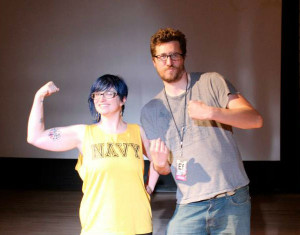
    We asked Hannah Piper Burns a few questions about EFF Portland. She will be presenting “Noble Gases: 2013 Director’s Pics” at ATA on Sunday, August 25th. Hannah directs the festival along with Ben Popp, also in the picture.hannah&ben2

    What can you tell us about the Experimental Film scene in Portland? What is the contribution EFF Portland is making?

    The experimental scene in Portland is very vibrant, and I think there’s still a lot of room for growth. There’s a lot of movement between generations of makers, which I love, with the academic institutions like PSU and PNCA, and there’s lots of people making on their own as well, and exploring new forms. EFFPortland aims to connect this community to the rich tapestry of experimental media across the US and beyond by creating an event that brings all this work into dialogue and creates an opportunity for these communities to come together and celebrate and strengthen each other.

    EFF Portland 2013 had over 12 screenings back in May with great attendance. What was the audience response like?

    We did! We also had an exhibition of installations and a night of performances curated and coordinated by Julie Perini and Jodie Cavalier, as well as several pre- and post-fest events, including an evening showcasing the Seattle Experimental Animation Team! We had great audience response. It was really cool to meet filmmakers from Chicago, North Carolina, Canada, and San Francisco, etc… and also locals we hadn’t met before, and get their feedback. It’s a great boost to keep going, keep making this festival a sustainable dream that can grow and be around for a long time.

    As a filmmaker yourself, what have you learned being the director vs. being a filmmaker in a festival?

    I’ve never had work in a festival myself, since my current work primarily lends itself to large-scale installation formats, and also my focus has kind of shifted lately towards EFFPortland and away from my own practice. I’m working really hard right now to shift it back. I will say that Ben has been very active at festivals like Ann Arbor and Experiments in Cinema and it seems to be just apples and oranges. I don’t want to intimidate anyone who is interested in starting or running their own fest, but it is a tremendous amount of labor. It’s basically another job that doesn’t pay. But I wouldn’t change anything – it’s a labor of total love. All of the stress and moving parts and kind of existential anxiety is all worth it in the end.

    What are some of the primary characteristics you look for in a film that would make a good addition to the program?

    Well, Ben and I watch everything together, which is a system that has really worked for us. We look at originality, or how someone is taking an experimental convention (of which there are many – just see our periodic table of the elements of experimental film!) and bending it in a new way. After watching over 500 submissions, you begin to really see which work stands out like that. We also look at the way someone uses their tools, and what they are ultimately trying to convey as far as a message, mood, or concept. But there are so many ways for a film to be experimental and it’s been a real joy to see that multiplicity manifest itself through the screening process. One thing I would say is we try to program films that wouldn’t have a home at Sundance or other non-experimental festivals. We are looking for things that really break form.

    What can you tell us about the films you are about to present at ATA included in “Noble Gases”?

    There’s a tremendous amount of range here, from experimental documentary to animation to semi-narrative. There are films by established filmmakers and there’s some, like “Up Ended”, which was a conceptual artist’s kind of first foray into this milieu of experimental film-making and the festival circuit. We’ve also got a film by Jeremy Moss, this filmmaker out of Pennsylvania who was in our best-of program last year as well. We love him. Ben and I thought these films exemplified their forms and we are very passionate about them.

    Where do you see the festival going in the future?

    Excelsior! has been my mantra since day one. It means “Ever Upward”. Ben and I are thrilled to start taking EFFPortland programs on tour (this screening is the first leg of that adventure!) and we are writing grants to try and facilitate that. I think we are both really invested in keeping this festival fun, accessible, diverse, multifaceted, and adhering to a high level of quality. We look at Bryan Konefsky of Experiments in Cinema as a mentor and an inspiration, big time. We’d love to attain nonprofit status so we can keep our development goals on track. And we are always kicking around ideas like opening up more of a distribution kind of thing. You eat the elephant one bite at a time.

    Why did you choose ATA as a venue for this program?

    Oh my gosh! Having lived in San Francisco, ATA has always been a beacon of experimental goodness for me, and I think Ben and I have both looked to ATA for inspiration when developing and growing Grand Detour, the microcinema that kind of gave way to EFFPortland. It’s a pleasure and honor to be here and to be able to introduce this audience to our mission and programming.

    Learn more