
Window Installation-“Media Archaeology: Anna Strong’s Revolutionary Clothesline”
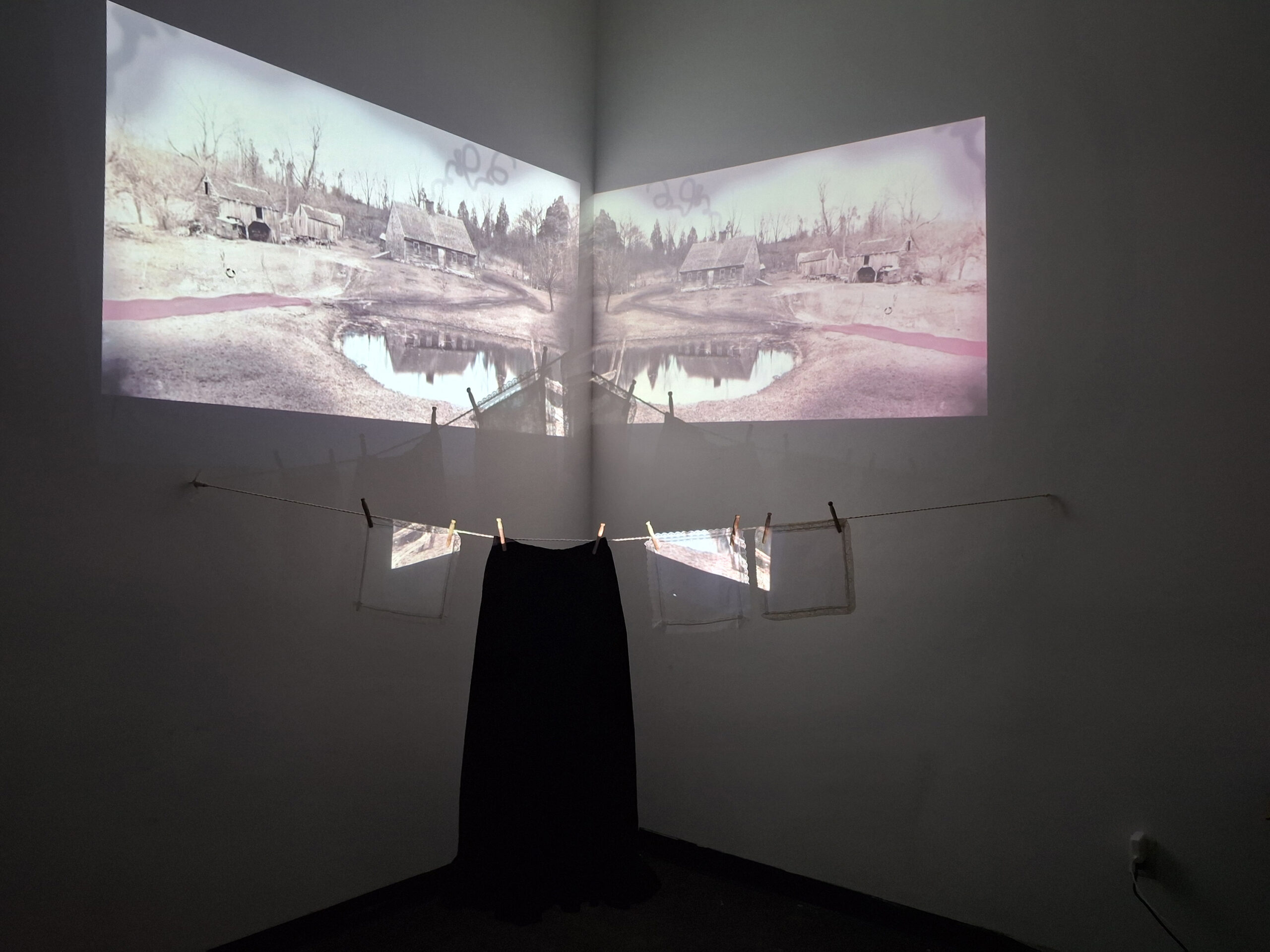
“Media Archaeology: Anna Strong’s Revolutionary Clothesline”
Casondra Sobieralski, 2026
Media archaeology is a Media Studies term that refers to the study of alternative and “unexcavated” media histories, whereby a medium is defined as anything that carries signals or information. Through that lens, Casondra seeks to claim a place in media and communications history for Anna Smith “Nancy” Strong.
Anna Strong, who lived in Setauket, Long Island (near Stonybrook), was likely the only female member of George Washington’s Culper Spy Ring during the American Revolutionary War. Anna kept watch for the arrival of an important agent, Caleb Brewster (agent 725). When his whaling ship arrived in Long Island Sound, according to folklore, Anna would string up
her clothesline to send a “code” to her compatriots. A black petticoat signaled that Brewster had arrived in the sound. Between 1 and 6 white handkerchiefs signified which of 6 harbors Brewster’s boat was docked in.
Abraham Woodhall (agent 722) would then take messages to Brewster; Brewster in turn passed Woodhall’s messages to Benjamin Tallmadge (721) who then took spy notes to agent 711 – George Washington.
Because patriarchy overlooks “women’s work” and women’s ingenuity, women can sometimes more easily evade detection by the watchful eyes of wartime authorities. For this reason, there is a rich history of women participating in espionage via their textiles. Examples range from Anna’s clothesline to women passing code through their knitting stitches during World War II.
For this piece, Casondra used AI (Claude) to generate a sewing pattern for a 1770s petticoat nd then sewed that garment plus the handkerchiefs. She researched historically plausible lace patterns at Lacis Textiles Museum in Berkeley, and 2 of the handkerchiefs feature vintage lace.