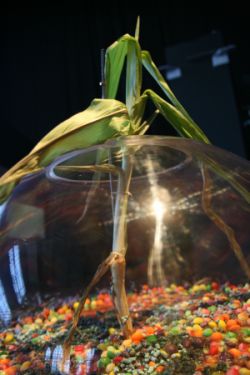
 Lexan Sphere, dirt, genetically modified corn, water, plant stand, stolen Skittles, stolen fruit-infused Garnier hair gel, stolen candy-like rat poison.
Through an opening in a large Lexan sphere I first laid down soil and planted in it genetically modified corn. I then gradually added Skittles, fruit-infused Garnier hair gel, and D-CON rat poison colored and shaped like candy, all stolen gradually from large chain stores.
Perhaps this thing will present a microcosm of the obscene excesses of global capitalism, as it invokes the spatial limits of growth that the smooth space of smooth capital seeks at every turn to negate. Creating artificially flavored/scented products beyond any basic human needs has become possible via man’s liquidation of natural elements for capitalist commodity production. The annihilation of nature through pesticides and rodentcides to create the space in which agricultural, industrial, and financial production can take place is not only a destructive force, but also constitutes and presupposes what counts as civilization, nature, and progress. The power of institutions in techno-scientific societies resides in their capacity to create and name social reality, and then impose on all this tissue of fabricated existence these instruments of diversion and mystification (taste the rainbow), while aggressively eradicating their social origin (food without GMO labels, nourishing hair gel, the naturalization of economic interests and the pricing of risk). This developing “laboratory planet,” as Bureau d’Etudes and Ewen Chardronnet have called it, promotes the manipulation of the living and social reality according to the doctrine of “acceptable risk.” The colonization of inner life grows and merges with that of our exterior environment through experimental political technology of an unprecedented order (Chardronnet, 2008). “Naturally”, those in the developing world assume a substantial and disproportionate share of the risks engendered by such experiments in global capital, while their “food security” is subject to and managed by corporate and finance capital interests. For now, the real horror happens there – Latin America, Africa, and much of South Asia – not here. Everywhere, the spectacle of annihilating any distinction between goods and commodities, or true satisfaction from a survival that, as Guy Debord said, increases according to its own logic, is accepted as necessary or even natural by the agents of multi-national corporations and finance capital. And so consumable survival must increase, because it continues to enshrine deprivation. “If there is nothing beyond increasing survival, if there is no point where it might stop growing, this is not because it is beyond privation, but because it is enriched privation (Debord, 1995).” This systemic and expansive neutralizing of subjective, heterogenous reality comes from the commodity, which can be thought as an indexer of “true satisfaction.”
The objects I have chosen to place inside the sphere are mental conceptions of the world that have become objectified forces via processes of capitalism. In this context, the objects form a conceptual constellation of the organization of productive forces particular to global capital. My intent is to use these objects to contribute to alternative mental conceptions of these processes, a new space for subjective activity, so as to imagine a change in the dominant social relations that these mental conceptions and objects flow from.
Skittles are mostly devoid of any nutritional value; while their manufacturer, Mars Incorporated, have executed documented examples of animal testing and environmentally detrimental production and distribution methods (PETA, 2008a). Yet the candies serve the transnational corporation’s necessity for ever-expanding markets (available in over 65 countries) while becoming successfully manufactured objects of desire for a global consumer-base in their perversely expanding varieties – Tropical, Wild Berry, Sour, Smoothie, Ice Cream, Carnival, Double Sour, Xtreme Fruit, Mint, Chocolate, Bubble Gum, and “Sensations”. As a “fruit candy” they contain a natural polymer known as “shellac” that is obtained from the secretion of a female insect, and gelatin, composed of animal bones, connective tissues, organs, and intestines. The brand’s successful instruments of diversion and mystification, such as their playing to customers’ affective investment in consumer choice and “taste the rainbow” marketing campaigns, tend to conceal the history of what these objects actually are. Mars Incorporated argues that due to private ownership, there is no need to account to anyone but themselves, and the company chooses not to cooperate with many widely publicized organizations such as Fairtrade (Mars, 2008). Mutilated animals, animal tested chemicals, and insect secretions become mutant fruit products, mutating consumer’s bodies and desires into an integrated space for the flows of capital.
Garnier is a division of L’Oreal that has become profitable with its “Fructis” line, which, in combining “science and nature,” is not only tested on animals (PETA, 2008b), but also uses a fruit concentrate to “give your hair the nourishing care it needs to look healthy every day.” This nourishing, fruit-infused gel replicates the care given in Garnier’s hair coloring, shampoos, conditioners, treatments, and serums. The necessity of this fruit concentrate, if it actually does help to “replenish liquids that the skin is lacking” and “stimulate the growth of the cells in the epidermis”, is not addressed. Perhaps Garnier, a company that claims their scientists are”constantly innovating and creating new technologies for your hairs needs,” are substituting science with informationalized capitalism’s cooptation and reorganization of scientific labor, of which private industry has now become the largest employer (US National Science Foundation, 1999). Further, one can speculate that the creation of these “needs” for human hair is meant to disguise not only the chemical ooze making up most of the hair gel but also the needs of and behind marketing a wholly unsustainable perpetual innovation economy. The unattainable true satisfaction of a self-aesthetic of scrunched curls, bursting shine, body & volume, or sufficiently shielded color is promoted, manufactured, and developed by the controlled experiments of a politicized techno-scientific capital. If our head-pieces are suffering from a lack of nourishment, might the growth and expansion of such capital, among others, be causing a change in our environment that creates this lack, a Petri dish world different from the Earth of the last 300 million years that mammals have been confronted with?
In May 2008 the U.S. EPA announced it would be tightening up safety on ten different rodentcides that are blamed for poisoning 10,000 children – mostly black and Latino inner city kids – every year. Those ten chemicals will no longer be available in the form of little pellets that look like candy and will only be allowed inside tamper-resistant bait stations. At any department store chain one can find the brightly colored pellets sold in loose-bait tray form, and will be able to do so for the next three years, as manufacturers are allowed to maintain business-as-usual until the EPA’s final “release for shipment” date of deadly bite-sized pellets in 2011(Pattison, 2008). But why the electric blueberry candy-color in the first place? Could it make them more attractive to small childrenwithout proper education and parental supervision, and so acting as another form of population control by eliminating those who often resist disciplined contribution to this global economic and social order, above and beyond the obvious target of rodents?
A human would perish in attempting to survive off a diet of Skittles, rat poison, and fruit-infused hair gel. Natural foods, or foods that were once natural and have since been modified, are still the core of a human diet. The argument for genetically modified crops goes as follows:
-we need to increase food production to feed the world
-yield increasing science has worked before
-the nay-sayers want to reduce output through organic agriculture
-Monsanto (a multi-national biotechnology company), on the other hand, is investing in science
-therefore we ought to embrace GM technology to fight the food crisis
Impoverished consumers not able to afford a sufficient diet (of goods) and reduced support for domestic agriculture is a potential for profit and so is distorted into a call for increasing crop output via GMO production. “Green revolution technologies” (yield increasing science) have brought about long-term ecological ruin as needs for climate-change-inducing fuel is required on farms for the production of fertilizers that have proved to be, along with pesticides, environmentally unsustainable. Monsanto, an agricultural biotech company, feeds off public sector research not in developing genetic traits, but patenting already existing traits and creating Genetic Use Restriction Technologies to protect their intellectual property (Patel, 2008). And as the current ethanol-from-corn boom so clearly demonstrates, having diverted 100 million tons of grain from human diets mainly to American car engines, “biofuel” may be a euphemism for subsidies to the rich and starvation for the poor. A chance to address climate change and the food crisis through sustained building of soil fertility (something GM can never do), integrated pest management, reduced energy footprints, sustainable energy alternatives and equitable local distribution systems is turning into an opportunity for a commodity of speculation and bargaining and an integrated network of power for the forms, functions, bonds, and organized transcendences of global capital. Here GMO corn becomes another form of population control, not only repressive in that its proliferation brings with it a massive depeasantization of the Global South, but also in how these globally administered short-term economic systems govern life and nature by determining what counts as “green,” “environmental,” “progress” and acceptable risk (such as the unknown future of a genetically modified world.) Elements that exceed those conceptual categories, such as organic agriculture, need to be destroyed in order maintain the forms of discipline that are required for genetically modified economic and social models.
The spectacle of annihilating any distinction between goods and commodities, or true satisfaction from survival in turn becomes a spectacle annihilating any distinction between needed goods and speculative goods. In other words, the goods actually needed for starving humans, and goods produced for financial control and growth. This conflation produces a range of knowledge and of means making it possible to intensify the involuntary responses to stimuli that promote the “advantageous” functioning of the managed civilization, to project a mentally-conditioned society of genetically modified consumers and to dream of worldwide techno-psychic control.
In the context of this project, my movement through spaces of capital was not driven by a desire for satisfaction through consumption. Instead I found myself amongst the overwhelming complexity of candy, pest control, and hair product aisles to shoplift these products as a form of defining certain problematics myself, and to define the conditions under which a satisfactory answer or response to these questions and problems might be obtained; however molecular the effect may be, they nonetheless attempt to contest the sacrifices art often makes within spaces of capital for the sake of its own existence. This gesture illuminates a hope for future forms of imagination and resistance to the cognitive and social walls that give us a false sense of powerlessness against integrating global capitalism.
To get involved with the food sovereignty movement, seek out Via Campesina, The National Family Farm Coalition, Grassroots International, Rural Coalition, Food First, and other like food and farm activist organizations.
Chardronnet, Ewen, Léonore Bonaccini, Xavier Fourt, Bureau d’études. 2008. Introduction. The Laboratory Planet No2.
Debord, Guy. 1995. Society of the Spectacle. New York: Zone Books.
Mars Incorporated. 2008. The Five Principles. www.mars.com/global/Who+We+Are/The+5+Principles.htm. (Accessed on 7/17/2008).
Patel, Raj. 6/13/ 2008. “The Opposite of Science.” www.StuffedandStarved.org. (Accessed on 6/15/ 2008).
Pattison, Fawn. 5/30/ 2008. Grist. “Candy Shaped Rat Poison on its Way Out.” http://gristmill.grist.org/story/2008/5/29/135928/265. (Accessed on 6/17/2008).
PETA. 2008a. “Mars Heartless Animal Experiments.” www.marscandykills.com/experiments.asp. (Accessed on 6/15/2008)
PETA. 2008b. “Companies That Do Test on Animals.” www.caringconsumer.com/pdfs/companiesDoTest.doc. (Accessed 8/30/2008).
US National Science Foundation, Scientists and Engineers Statistical Data System. 1999. Table C2. “Employed U.S. Scientists and Engineers, by level and field of highest degree attained, sex, and employment sector: 1999.”
andandrewrew AT gmail.com

