Blog

  • Call for Submissions: SF Cinematheque CROSSROADS Festival 2013

    San Francisco Cinematheque seeks submissions of recent films and videos for CROSSROADS 2013, the fourth manifestation of our annual film festival. Occurring the first weekend in April, 2013 at San Francisco’s Victoria Theatre, CROSSROADS 2013 will showcase new film/video works by emerging and established filmmakers, including performance and works of “live cinema.” Cinematheque seeks submissions of compelling non-commercial, artist-made work of all genres and durations.

    ENTRY GUIDELINES
    — Submitted works must have been completed after January 1, 2011.
    — Include one submission form with each entry.
    — Submissions are accepted on DVD and in the form of streaming online video. See entry form or online submission form for details.
    — Please include a pre-paid, self-addressed package with your submission if you would like items to be returned.
    — Entry fee: $10 for each individual film (postmarked by Dec. 31, 2012); $15 for each individual film (postmarked by Jan. 30, 2013). Entry fee is waived for Cinematheque members.
    — Please make checks or money-orders payable in U.S. currency to: SAN FRANCISCO CINEMATHEQUE; electronic payments can be sent via Paypal to festival@sfcinematheque.org
    — CROSSROADS 2013 will (potentially) screen work in the following film/video formats: 8mm, Super-8mm, 16mm, 35mm, QuickTime ProRes and
    Blu-ray. Please contact festival@sfcinematheque.org with inquiries concerning additional exhibition formats.
    — All entrants will be notified on receipt of submission(s).
    — Contact us at festival@sfcinematheque.org for more information.

    RENTAL FEES PAID FOR ALL WORKS SCREENED AT THE FESTIVAL.
    For complete entry details, including a downloadable entry form (and *NEW* online entry form), please see:
    http://www.sfcinematheque.org/#/calendar/201212310/
  • Struggle at ATA

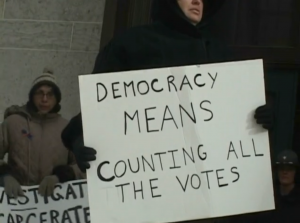
    On Friday, November 2nd, filmmaker, activist, and native Ohioan, Roger Hill, joined us at ATA for a screening of his film, Struggle, an inquiry into voter suppression, manipulation, and fraud at the Ohio polls in 2004. In light of recent efforts to suppress the vote, and with Ohio poised to play a similarly decisive roll in the outcome of the 2012 presidential election, Struggle is both timely and disquieting. During election season, it is tempting to sink into apathy and disillusionment, to throw up one’s hands at the bloated march of interested money and agitation rhetoric. Hill’s earnest effort to expose injustice reminds us that our participation matters, not just in terms of casting a ballot, but also in raising an alarm when we witness something that’s seriously f**ed up.
    I’d like to encourage anyone reading to visit Struggle’s website, and any filmmakers to document the voting process as you witness it (pen: sword, camera: automatic weapon). Public opinion makes a difference.

    That said, a social justice film runs the risk of preaching to the choir. Struggle is not bipartisan– Hill and his camera are firmly located among the protesters, and there one moment particularly where the film indicts the uninformed citizen. In a street interview, a man says that if the vote was really being suppressed, people would be upset about it. The footage cuts immediately to the protesters holding signs about the suppressed vote. This juxtaposition effectively creates an us and them statement, but it might have been used to illuminate the real communication failure between the people who have been disenfranchised and those who haven’t.

    I believe that the vast majority of American people oppose voter suppression, but they are convinced by their media sources that it’s not really happening. A film like Struggle could potentially reach those unbelievers. The footage of voters waiting in long lines in the rain, and the interviews with election observers are some of the most powerful moments in the movie. It’s fine for Struggle to rally the liberal troops, but what would be really revolutionary is if it took those images and showed them to the guy in the street interview.

    Between interviewing voters on the ground, and researching tactics of data manipulation, the film covers a lot of ground. From a pure watchability standpoint, I would have appreciated some comic relief. Humor goes hand in hand with struggle; it empowers, and I bet people made some good jokes while they were waiting in those ridiculously long lines.

    It’s a real feat on the part of Hill and his team to have put this project together. If you feel helpless against the powers that be, this is a reminder of the power of voice in the age of modern technology. Watch the movie. Support the cause. Vote.

  • Small Press Traffic: A reading and conversation with Dana Ward, Julian Brolaski and Cynthia Sailers

    A reading and conversation with Dana Ward, Julian Brolaski and Cynthia Sailers.

    Since 1974 Small Press Traffic (SPT) has been at the heart of the San Francisco Bay Area innovative writing scene, bringing together independent readers, writers, and presses through publications, conferences, talks, and our influential reading series. Small Press Traffic Literary Arts Center promotes and supports writers from all over the globe—particularly those who push the limits of how we speak and think about the world. Kindly and graciously housed at the California College of the Arts, we remain autonomous and thus depend upon outside funding for our operating expenses.