Each month, we are featuring interviews with the volunteer staff that make ATA possible, recognizing their work at ATA and their contribution to our vibrant artistic community.
Here are the interviews with our Gallery Director Grace Rosario Perkins and ATA Board Member Shae Green.
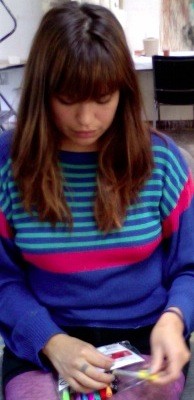 GRACE ROSARIO PERKINS
Can you tell us about your first volunteering experience/s at ATA?
I started volunteering at ATA in 2007. I was attending Mills College and I think I had just switched from being an Art History major to an Intermedia Arts (video/sound/installation) person so I became more interested in working with alternative video/film spaces as opposed to galleries and museums. I was also most interested in microcinemas and film programing because a few years prior I had met Astria Suparak who was a film programmer who toured the country multiple times screening really amazing shows. All of these interests just culminated in me seeking out a similar community. I hadn’t even been to a show at ATA, I just started volunteering. I can’t remember what the first show I worked was but when I first started I remember there being a film series at ATA that showed a lot of really crazy stuff like Fred Halsted. I also remember working one of the last Madcat Film Festivals and there was some real excitement in the air that night.
You are an artist and part of the Black Salt Collective. Has being involved with ATA inspired you in any way, and if so, how?
I think being at ATA has informed my practice in a lot of ways. It is a space that allows me to engage with a very specific community of creative people and virtually every time I go to ATA I see something completely unlike the previous show… ATA pretty much runs of the gamut of film and music shows. It’s always fun to just stop by and see what is happening. I find ATA to be a nice space that is extremely accessible to many types of programming and because of that exposure I at times find myself feeling pretty motivated to try new things, even if it’s as simple as seeing someone doing something with projection… A “Why haven’t I done that?” kind of thing. Not that I always do it but at least it gets me thinking.
You run the ATA Gallery. What does your job as the gallery curator and manager entail?
I find artists every month to show their work on the ATA gallery walls. There is often the occasional opening or closing party and I am kind of the point person for times and dates, helping artists with anything else that may arise. Ideally I would like to host more group shows so if there are any curators out there that have a concept for a show, please email me: gracerosario @ gmail.com or just any artists looking for a space to show their work.
What do you do as for your day job?
I work at Creativity Explored as a Visual Arts Instructor. I’ve been working with adults with disabilities for a long time now, working at pretty much every art center in the Bay, and its work that I really enjoy. At Creativity Explored, I work with people on a lot of different projects- drawing/painting, sculpture, video, sound, and lately have been lucky enough to put some shows together. I usually have artists work on larger projects that are usually conceptually based and am currently finishing up some short abstract videos for projection for an upcoming show titled SPACE that opens May 2nd at the Creativity Explored gallery. I co-curated the show with another instructor Miranda Putman, and the exhibition is being promoted as “an immersive gallery experience consisting of sculpture-based work made from repurposed materials paired with sound, video, and light components.” It’s pretty exciting because Creativity Explored hasn’t really had a show with this sort of focus and in addition to that, the artists themselves have been invited to be a crucial part of the actual installation process creating an environment entirely of their own.
Why is ATA important to you? And to the community?
ATA has been around for almost 30 years. It’s crazy. Spaces like this need to exist, otherwise we’d just have really boring, dry art spaces run by people with money and little heart. It’s very crucial to keep these spaces afloat, specifically spaces run independently by a crew of volunteers who more or less have a pretty substantial commitment to the space. Look around the Mission, specifically Valencia Street, ATA is pretty much a one of a kind place these days and people need to support it to keep it alive.
What would you say is needed to volunteer at ATA?
An interest in watching experimental films or documentaries. A little patience. ATA is kind of just a big vessel and you can pour your ideas into it and most likely create your own interesting series or shows or art exhibits and that is what is the most enticing to me, so I feel like if that’s your thing, ATA is a good place to hang out.
What is the craziest or coolest thing you have seen at ATA so far?
About a year ago I brought a few artists from Creativity Explored to come work in the ATA Window Gallery to create a collaborative installation and they were pretty psyched. One artist talked about it every day… “We’re gonna go back and paint on the window?” I think just the excitement of taking their art to a public space with very different perimeters was really exciting for them and to be there to see them experiment was pretty great. That was kind of a cool synthesis of my worlds. I also find our fundraisers extremely fun– a lot of socializing, dancing, whatever. Good vibes all around at those things and kind of illuminates the validity of this community for me and many others.
 SHAE GREEN
How did you first become involved with ATA?
I wanted to learn about video production and ATA offered free workshops to volunteers. I signed up. Thirteen years later, I’m still here.
You started volunteering at ATA in the late 90′s . Can you tell us how ATA has changed since?
A lot has changed technology-wise. We used to have computer labs with big clunky Mac IIs and linear editing suites with an effects generator called a Video Toaster – yes, raining sheep was one of the transition options.
What do you do nowadays at ATA?
I’m on the Board of Directors and I just finished creating a Volunteer and Technical Handbook. ATA is an informal place, but we want to ensure new volunteers have the information they need.
Why is ATA important to you? And to the community?
ATA is my oasis. I meet great people – other volunteers, artists, community members – and get to participate in the presentation of art. ATA is important to the community because it offers an opportunity to gather, view and present art and ideas that are outside of the mainstream.
What is something you have done at/for ATA that you feel very proud of?
For six years, Isabel Fondevila and I curated ATA’s Film & Video Festival. What started as an idea casually discussed in the office became a reputable event. With inspiration and hard work anything is possible.
Volunteer with ATA!
ATA is looking for volunteers to help with our Gallery and our Screenings. Volunteers run screenings, organize events, curate shows, and get stuff done. Volunteers can come to any ATA show for free. We need people who are creative and reliable.
Email volunteer@atasite.org and become a part of something good.