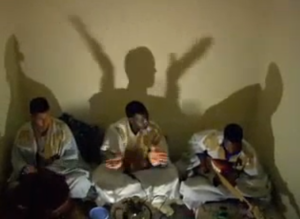
Hisham Mayet visited ATA this week with two impressionistic documentaries from his archive. Both films, Palace of the Winds, and Folk Music From the Sahara: Among the Tuareg of Libya, explore the musical and cultural practices of North African Muslim communities, isolated from the region’s major thoroughfares by vast and windswept deserts, but connected enough to modern technology to employ phase shifters on their electric guitars.
Mayet is the founder of the record and film label Sublime Frequencies, a world music project with a special interest in ritual and folk music. His storytelling complemented the presentation, and gave the audience an entry point into the music and imagery. His account of traveling South on the Moroccan coast, drinking bittersweet tea in a series of living rooms, looking for a song that he had almost missed on the radio.. I felt his thrill in the journey , his passion for the music, and the way that music can connect us. I imagined his tea-serving hosts drawn into the mystery; who sings this song and where does he come from?
 As a portrait of a place, the films are opaque. In Palace of the Winds, particularly, the viewer has a profound sense of watching through the lens. I felt that the camera was always present in this film; it was my window into the place, but the glass was thick on that window– I peered through it and so did the film’s subjects. Children mugged for the camera, and women giggled and turned their faces away. It’s standard practice to cut these shots out a documentary and I was glad that Mayet didn’t. A foreign culture will always be opaque to travelers with camera eyes. Let the film articulate that distance, rather than try to trick it.
The music was exceptional. These are music films, after all, but I wanted to hear the sounds of the space itself. I wanted to hear the wind howling through the open windows of the houses, and banging the plastic tarps that were rigged all over to keep it out. I thought that this desert music must be in conversation with the space where it exists, and while the camera wandered over the goods at the market, leered from a hanging lamb’s head into the dried husks of lizard bodies, I missed the sounds of that space. The film reached its peaks when the music and imagery fell into sync. A singer clapped his hands beneath his own enormous shadow. The camera panned across a sea of wedding women; restless and excitable, their hands fluttered to their candy-colored headscarves.
The second piece was filmed at a festival in Ghadames, Libya. It is an ode to Tuareg pageantry. In contrast with Palace, Music From the Sahara brings the camera right up to its subject, moves in rhythm with the dancers. At times it felt like the camera was jousting with the camels whose noses pushed into the lens. We barely saw their riders, high on the hump. I was interested to see so many female musicians. It’s rare to see a woman drummer, and they were all over both of these films. The camera spends a lot of time with these women, with young girls in traditional dress, and with the female musicians. I couldn’t help wondering if these are the women from the film’s description, “..some of the most beautiful women in the world”. I think that phrasing does a disservice to the piece– it implicitly exoticises and objectifies the film’s subjects. (“..as a connoisseur of women, I find this tribe particularly striking..”). But, forgive my pet peeve. It’s just a quip with the blurb. There is no text in either film, no commentary. The films are about music and looking.
Without text, without story, the films are slow. They are not edited in the familiar arc-like structure. I appreciated the long takes for what I read as the length of each session, the movement of time in those places. The reward for our patience is that the filmic experience of these events is closer to the lived experience. Our moments of looking are not mediated by language of mainstream documentary. At the same time, I would have appreciated more editorial control. In Music From the Sahara especially, the fade in, fade out cuts became repetitive.
Near the end of Music From the Sahara, the camera pans to the audience. It becomes clear that we are watching a performance, that these dances have already entered the realm of “culture”; these are traditions that are deliberately preserved. In the sea of spectators, a young girl is standing on her chair, moving to the music. Watching her, I appreciated the light touch of these films. They enter the struggle to preserve, classify, and disseminate the rich fruit of folk music and performative tradition, but they don’t talk about it. They just stand there and bear witness.


