Blog

  • Celebrating Jonas Mekas Special Screening of Mekas’ Birth of a Nation (1997)

    Admission: $10 General/$5 Cinematheque Members
    Advance tickets available here

    In the very end, civilizations perish because they listen to their politicians and not to their poets.
    —J. Mekas
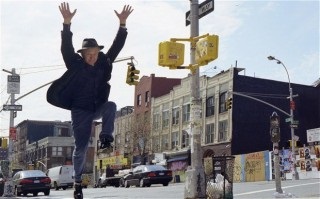
    Jonas Mekas (1922–2018), tireless advocate for the underdog, was without a doubt the world’s foremost advocate for personal/underground/avant-garde cinema. As a poet, publisher, filmmaker, curator, critic, archivist, rabble rouser and hopeless romantic, his cultural influence cannot be underestimated. Born in Semeniskiai, Lithuania, Mekas emigrated to the U.S. in 1949 (after imprisonment in a Germen labor camp and life in a displaced persons camp), fell in love with New York City and immediately took to filmmaking, a practice he maintained to the end of his life, eventually pioneering the personal diary into an epic film genre. By 1955 he was co-publisher (with his brother Adolfas) of Film Culture, a journal articulating the aesthetics of underground cinema which was published quarterly until 1995, while his Village Voice column “Movie Journal”—which ran 1958–1978—presented weekly updates on the New York underground scene of the day while cultivating community and bracingly attacking mainstream cinema. A visionary infrastructuralist, Mekas’ establishment of the Film-Makers’ Cooperative (in 1962) and Anthology Film Archives (in 1970) ensured that underground and personal film would be preserved and cherished for generations.

    In this screening San Francisco Cinematheque and Canyon Cinema celebrate the life of Jonas Mekas with a special screening of his 1997 film Birth of a Nation (1997): 160 portraits/appearances, sketches and glimpses of avant-garde, independent filmmakers and film activists, filmed 1955—1996, a celebration of Mekas’ artistic community and adopted homeland.

    Why Birth of a Nation? Because the film independents IS a nation in itself. We are surrounded by commercial cinema Nation same way as the indigenous people of the United States or of any other country are surrounded by the Ruling Powers. We are the invisible, but essential nation of cinema. We are the cinema. (Jonas Mekas)

    List of filmmakers and related friends and film activists who appear in the film, in order of appearance: P. Adams Sitney, Peter Kubelka, Ken Kelman, Hollis Melton, Ken Jacobs, Larry Jordan, Florence Jacobs, Harry Smith, Henri Langlois, Annette Michelson, Gerald O’Grady, Hollis Frampton, Sidney Peterson, James Broughton, Joel Singer, Stephen Dwoskin, Dore O., Werner Nekes, Kenneth Anger, Andrew Noren, Jacques Ledoux, Ed Emshwiller, Saul Levine, Larry Gottheim, Pascale Dauman, Ray Wisniewski, Taylor Mead, Michael Snow, Ricky Leacock, Stan Brakhage, Jane Brakhage, Barry Gerson, Willard Van Dyke, John Whitney, Pola Chapelle, Morris Engel, Stan Vanderbeek, Amy Greenfield, Bruce Baillie, Chantal Akerman, Sally Dixon, Will Hindle, Michael Stuart, Robert Creeley, Friede Bartlett, Scott Bartlett, Jud Yalkut, Adolfas Mekas, Callie Angell, Charles Levine, Bhob Stewart, Nelly Kaplan, Claudia Weil, Annabel Nicholson, Birgit Hein, Piero Heliczer, Peter Gidal, Kurt Kren, Wilhelm Hein, Malcolm Le Grice, Carmen Vigil, Bill Brand, Regina Cornwell, Akiko Iimura, Taka Iimura, David Crosswaite, Gill Eatherley, Amy Taubin, Tom Chomont, Peter Weibel, Carla Liss, Robert Huot, Guy Fihman, Claudine Eizykman, David Curtis, Barbara Rubin, Kenji Kanesaka, Anna Karina, Leo Dratfield, Gregory Markopoulos, Robert Beavers, Robert Kramer, Pamela Badyk, Cecille Starr, Jerome Hill, Donald Richie, Fred Halsted, David Wise, Sheldon Renan, James Blue, Ernie Gehr, Richard Foreman, Robert Polidori, Leni Riefenstahl, Amalie Rothschild, Lillian Kiesler, Shigeko Kubota, Jerry Tartaglia, Dan Talbot, Louis Marcorelles, Michel Auder, Dwight MacDonald, Viva, Leslie Trumbull, Kit Carson, Paul Shrader, Shirley Clarke, Bosley Crowther, Dimitri Devyatkin, Ulrich Gregor, Sheldon Rochlin, LaMonte Young, Robert Gardner, Vlada Petric, John du Cane, William Raban, Tony Conrad, George Maciunas, Alberto Cavalcanti, Jim McBride, Peter Bogdanovich, Gideon Bachmann, Christiane Rochefort, Jerry Jofen, Rosa von Praunheim, Hans Richter, Roberto Rossellini, Lionel Rogosin, Robert Haller, Storm De Hirsch, Marcel Hanoun, Jerry Hiler, Bruce Conner, Myrel Glick, Paul Sharits, Barbara Schwartz, Lewis Jacobs, Ian Barna, Carolee Schneemann, Anthony McCall, Diego Cortez, Leslie Trumbell, Adolfo Arieta, Louis Brigante, Coleen Fitzgibbon, Stewart Sherman, Charles Chaplin, Len Lye, Tati, Allen Ginsberg, Valie Export, Hermann Nitsch, Andy Warhol, Jack Smith, Analena Wibom, Robert Breer and Raimund Abraham.

    Film’s soundtrack features rare compositions by Hermann Nitsch

  • Another Hole in the Head Presents: “ARTIFACTS”

    Please join us for an encore screening of “ARTIFACTS” – a curated collection of Art and Experimental films which screened at our 2018 festival. This will be the first show at ATA, and we hope to present other films from our archives in the months ahead.

    Tickets: https://www.ahith.com/events/artifacts-art-experimental-films-encore-presentation

    About Another Hole in the Head:
    This festival (unofficially and affectionately known as “HoleHead”), has been presenting films under the auspices of the San Francisco Independent Film Festival for over 15 years. While we are primarily a Genre festival, we choose to include a broader spectrum of film than that designation generally allows. Therefore, all styles of independent film are welcome to compete. Whether it’s a major production from a professional company, a student film, or a micro-budget labor of love, we are committed to giving each film due consideration.

    Do you have a film you’d like to enter? We’re currently accepting submissions for our 16th Annual Festival (December 2019) through FilmFreeway:
    https://filmfreeway.com/SanFranciscoAnotherHoleintheHead

    LINEUP

    140 Characters
    Directed by Dean Winkler
    (2017, 6 min, USA)
    “What happened to the future we were promised? Why did we get Twitter instead of intelligent media that enhances society? Why are we developing silly apps instead of hardware? All enabled by our so-called “smart phones” which trap us like the prisoners in Plato’s cave – detached from reality and unaware.” – Director’s Statement

    Dance To The Music In Your Heart
    Directed by Qiying Lin
    (2017, 8 min, USA)
    Experimental portrait of Bay Area native Antoine Hunter, director and founder of Bay Area Deaf Dance Festival and the Urban Jazz Dance Company (UJD). Created in 2007, UJD provides professional opportunities for Deaf and other-abled artists.

    Delicious Light
    Directed by Gaia Marcaccini
    (2018, 4 min, USA)
    A cataclysmic event is unleashed when a deity unknowingly releases a bad seed into the universe. A sacrifice must be made in order to return light to the world.

    Horror Vacui
    Directed by Matteo Zamagni
    (2018, 4 min, UK)
    Horror Vacui is the Latin phrase for the fear of empty space. By apposing computer generated images and real-world footage the video blurs the distinction between reality and a digital recreation of it, questioning the act of perceiving and the biased notion of ‘reality’.

    Huerta de San Vicente (The Orchard of St. Vincent)
    Directed by Patricia Vonne
    (2017, 4 min, USA)
    An animated homage to Federico Garcia Lorca, the Spanish poet & playwright who, in a career that spanned just 19 years before his untimely death, resurrected and revitalized the most basic strains of Spanish poetry and theatre.

    Icons
    Directed by Ronnie Cramer
    (2018, 5 min, USA)
    Five hundred years of world art in five minutes, as rendered in nylon-tip pen and animated by award-winning artist Ronnie Cramer.

    Inactivity
    Directed by Ryan Wicks
    (2018, 2 min, USA)
    Soaring through nostalgic computer screensavers as an offscreen narrator warns about the dangers of the meat packing industry.

    The Knits
    Directed by Lisa Birke
    (2017, 10 min, Canada)
    A sweater, lovingly and arduously knit by a mother, incrementally unravels as her daughter treks her way across Canada by foot. Along the way, the film tugs at the crossed threads of familial ties, art versus craft, gendered materiality, and the relationship we have with mother nature and her great divide.

    Lezginka in Paris
    Directed by Kirill Fessenko
    (2018, 5 min, Canada/France)
    A choreographic short film which sets an aggressive traditional dance in the limestone labyrinths of Parisian streets.

    Masters of War
    Arminio Stephano Rivero
    (2017, 6 min, USA)
    A faceless politician delivers a speech on the fate of the nation. [The speech featured in this film is derived from a combination of real life speeches given by U.S. Presidents when declaring or threatening war.]

    The Meaning of Life…
    Directed by Atomic Elroy
    (2018, 4 min, USA)
    A Dadaist film, dealing with the over saturation of media in our culture and society. “We no longer make culture we make a media dump or junkyard.”

    Mimesis
    Directed by Patrick Lee
    (2017, 4 min, USA)
    Mimesis, a Greek word, refers to the representation or imitation of the real world in art and literature. Nothing in the film is digital. All visuals are analog, created using miniatures, home-made machines, smoke and mirrors. Plato and Aristotle saw in mimesis the representation of nature. The director seeks to depict other beings harnessing these forces to create a super nature while no one seems to notice.

    Movement
    Directed by DeWayne Austin
    (2017, 12 min, USA)
    The magic of man, materials and movement through manipulated time lapse.

    Pee Free Pool
    Directed by DeWayne Austin
    (2018, 1 min, USA)
    A mock PSA from the PFP (Pee Free Pool Association of America).

    Phototaxis
    Directed by Melissa Ferrari
    (2017, 7 min, USA)
    Rooted in nonfiction, this film contemplates synchronicity and the role of belief systems in perception; the tendency to assign supernatural meaning to tragedy and the unknowable; anonymous and apocryphal oral histories; and the moth to the flame. It draws parallels between Mothman, a prophetic and demonized creature in West Virginia lore, and Narcotics Anonymous, the main treatment program in West Virginia’s addiction epidemic. To visualize these narratives, natural materials and pastel-on-paper palimpsest animation are woven together using a multiplane and analog overhead projection.

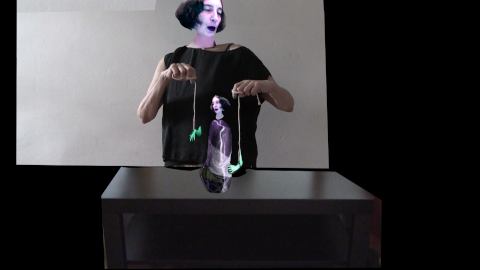
    Reverie Of The Puppets
    Directed by Kathy Rose
    (2018, 6 min, USA)
    In this video the viewer is taken to a surreal landscape of great beauty; a land of trees that subtly shifts into more hallucinogenic terrain… At the end, the dreamers dream, and the sleepers sleep.

    ROUSE
    Directed by Ramón Rodríguez
    (2017, 5 min, USA)
    By using contrasting and deliberate visuals, this film is a reflection of some of the everyday routines of humans in New York City, and some of the perceptions of what supposedly defines us, with the intention of shattering those very same perceptions. Includes music by Giuseppe Verdi, and a recitation of the Ginsberg poem, “The Eye Altering Alters All.”

    The Secret Life of Art
    Directed by Catherine Mosier-Mills
    (2017, 4 min, USA)
    What if art came to life at night? Do works of art have personalities? Do they wish to escape their assigned interpretations and roles? How do these works hold up in a modern context? This digitally-animated piece brings to life well-known works by masters such as Michelangelo, Raphael, Degas, and Gauguin, and explores what would happen if they could interact with each other during a chaotic night at the museum.

    WANDERERS
    Directed by Christine Banna
    (2017, 3 min, USA)
    High resolution images from the Mars rovers were physically printed out, then re-digitized under a microscope. The lens of the microscope makes Mars more tangible by making evident the uneven surface of the paper and juxtaposing it against the uneven surface of the Martian landscape, the ink mimicking the pitting on Mars’ surface.


  • OpenScreening

    Free

    openscreening.jpeg.pagespeed.ce.NgD79VABiR

    ATA’s Open Screening is the only monthly open submissions screening in the Bay Area. Get your work out there!

    Open Screening is where we invite local filmmakers to show their short subject films (under 15 mins.). It is a free event and you can either screen a film or just be a member of the audience. Either way it is FREE. It is a great place to network, if you are a filmmaker, crew member, actor or a fan of local films. Please let us know if you would like to screen something. We love films and would love to see yours.

    Submissions: Label all tapes w/ name, contact, title and length. Mail to: Open Screening, 992 Valencia, SF, 94110.  1-2 weeks advance submissions strongly recommended. If not, just walk in before the show. Maximum length: 15 min. Formats: Digital File (PC or Mac),  DVD, miniDV/DV-cam, VHS, beta, 8mm and 16mm. For 8mm and 16mm films give us advance notice.

    Door opens at 7

    contact: programming@atasite.org