
On view through May 2026 in ATA’s Galleries: short films of legendary video artist Copper Giloth

Copper Giloth, Modeling the Female Body

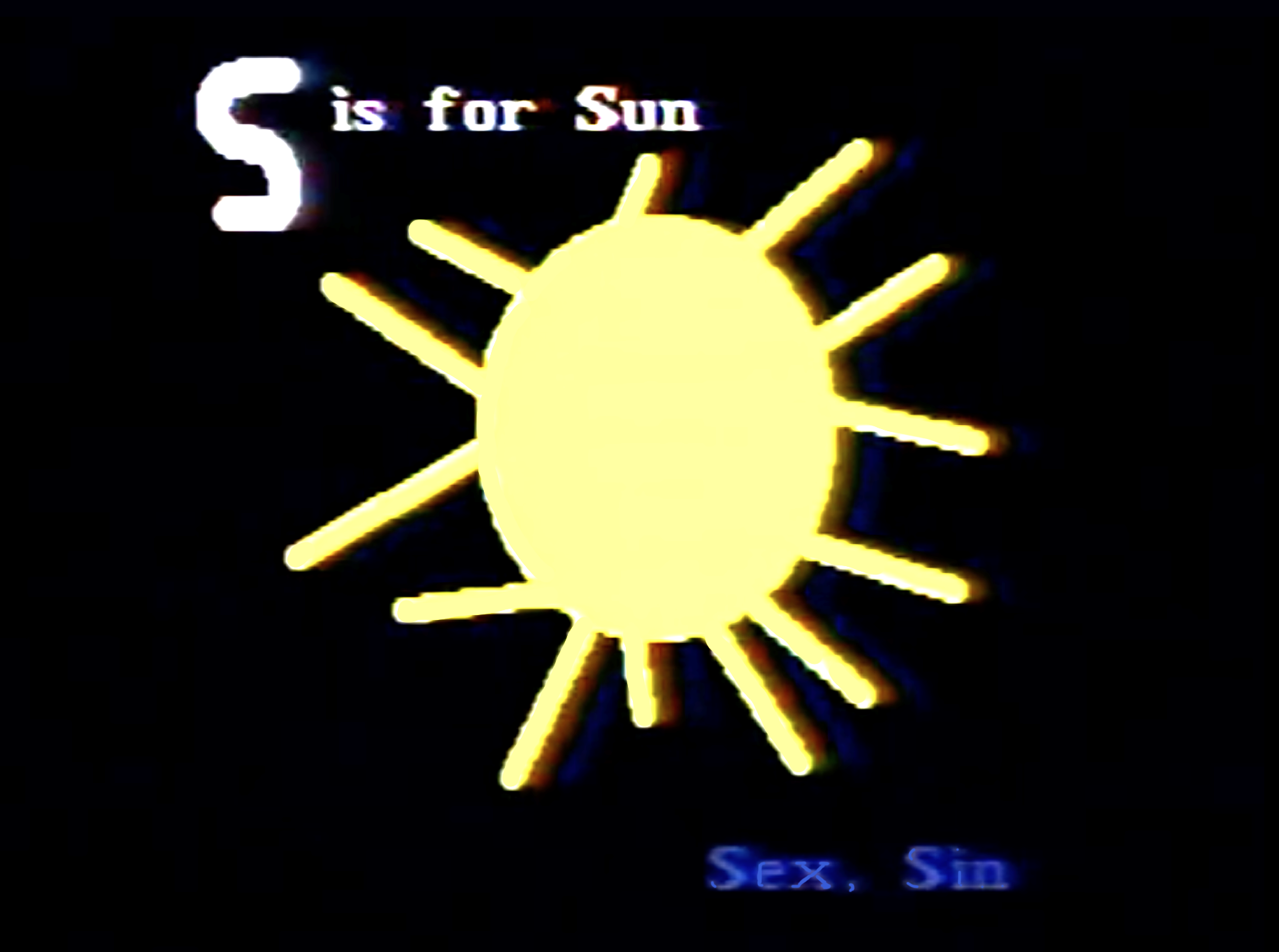
Also on view:
Ballyoid Cardioids (1979)
Skippy Peanut Butter Jars (1980)
AS I SAID (1980)
Childhood Logic (1980)
Alphabet Song of A Young Girl (1986)
The Red Table (1986)
Modeling the Female Body: A Survey of Computer Generated Women, 1980-1993 (1994)
Gallery hours: 2-5pm on Sundays in May
or, request an appointment to view: alex@atasite.org
Copper Giloth‘s Feminist Computer Art explores a formative decade in the work of artist Copper Giloth, tracing her pioneering contributions to early computer art. After encountering computers while working as a welder in Massachusetts, Giloth pursued graduate study at the University of Illinois Chicago’s groundbreaking Electronic Visualization Lab, becoming part of the first generation of Chicago new media artists. During this period, she also embraced feminist liberation politics, which became central to her emerging artistic approach.
Focusing on the late 1970s through the 1980s, the exhibition highlights Giloth’s experimental integration of video and computer graphics, emphasizing her innovative use of programming as a creative medium. Her works investigate the expressive potential of code, foregrounding elements such as the glitch, repetition, and the generative possibilities of early programming. Through these strategies, Giloth transforms digital systems into sites of visual and conceptual exploration.
Crucially, Giloth’s engagement with emerging technologies constitutes a feminist practice. Working within a field historically dominated by men, she asserts authorship over computational tools while challenging assumptions about gender and technical expertise. Her use of code as an open, generative system resists fixed hierarchies and embraces multiplicity, aligning with feminist commitments to collaboration, process, and the destabilization of authority.
By revisiting this pivotal era, Copper Giloth‘s Feminist Computer Art underscores Giloth’s influential role in shaping the language of early computer art and affirms the lasting impact of feminist perspectives within technological practice.
–Helena Shaskevich,
Artists' Television Access
Weekly Newsletter
Coming Up This Month
Friday, July 24, 2026, 7:00 pm, classic-editor
Opening Reception: Deterrence
 Deterrence is a multimedia exhibition showcasing works by Latine, Chicano, and immigrant artists that critically engage with the United States’ official foreign policy and border security strategy known as Prevention Through Deterrence. The exhibition will feature artists working across painting, sculpture, photography, and video, each addressing a distinct facet of this strategy and its consequences. Themes include the expansion of surveillance technologies, the utilization of hostile terrain, the weaponization of resource scarcity, and the emergence of grassroots resistance. Each work will offer a distinct perspective, creating a deeper understanding of the human and political toll shaped by this policy.
Saturday, July 25, 2026, 5:00 pm, classic-editor
Closing Reception: Variety Show
 Closing ceremony for this month’s window gallery show, “On The Wonk,” the variety show will feature 16 micro acts. From a magician, to a first time unicycler, to a somber monologue on being a chimney sweep in the 1800’s, the variety show is sure to have something for everyone.
Gallery Exhibitions
Thursday, July 30, 2026, 7:00 pm, classic-editor
Deterrence
Window Installations
Thursday, July 30, 2026, 9:30 pm, classic-editor
On the Wonk
 Feeling slightly off…? A little crooked? A bit unstable? Has your boss been growing fur? Is your local dog catcher reciting poetry? Has the grass on your neighbors lawn been tasting a little sweeter? Is that bug following me? Perhaps then you should kick your shoes off, slip into something a little more peculiar, and join us On the Wonk!
“On The Wonk” presents a world of new works by Kiera Griffith and Noah Gavrich, with help from technician Egon “Eggman” Conway. The multidisciplinary trio work with animation, fiber arts, painting, and ceramics, collaborating on a miniature world that mirrors San Francisco, asking isn’t this wonky? The dozens of small works are illuminated with lighting cues that change at night, and become animated at the push of a button.
Noah Gavrich was farmed locally in San Francisco and studied animation at the Rhode Island School of Design. He works across all visual mediums. He gets into a new hobby every few months. Currently it is whittling. He is a libra.
Kiera Griffith is an artist amongst whatever medium the wind strikes. As long as it’s just a little bit silly. A person who enjoys making, and hopes to inspire you to do the same one silly little thing at a time.
You can see more of their work on their instagrams; @nogsgrog and @kieradom
About Artists' Television Access
Artists' Television Access is a nonprofit 501(c)(3) artist-run
screening venue and gallery located in the heart of San Francisco's Mission
District. ATA is supported in part by Grants for the Arts/San Francisco Hotel
Tax Fund, The Christensen Fund, individuals members, donors and volunteers.
CELEBRATING 25 YEARS OF EXPERIMENTAL MEDIA: Join ATA as a member and receive exciting gifts, including the 2008 DVD compilation, T-shirts, and free admission to screenings and more! Artists on the 2008 DVD compilation include: Yin-Ju Chen, Mike Rollo, Marthaxiv, Sam Manera, Wago Kreider, Federico Campanale, Paul Clipson and Carl Diehl. http://www.atasite.org/membership/
How to Reach Us:
Artists' Television Access
992 Valencia Street (at 21st)
San Francisco, CA 94110
(415) 824-3890
ata@atasite.org
Gallery is open before and after screenings for viewing.
Screenings start at 8pm unless otherwise noted.
Directions: Take Bart to 24th Street Mission. Walk 1 block east to Valencia and 3 blocks north. ATA is located between 21st and 20th Streets.